this entry is a continuation of entry 19 – maps of worldbuilding 01, if you haven’t checked yet, be sure to click the button:
I’ve explored the importance of maps for worldbuilding and fiction, examining maps of our world (in Tolkien’s words, ‘the primary world’) created within past cultures and their technologies. Now, drawing further from Wolf’s Building Imaginary Worlds, I want to explore maps belonging to invented worlds (Tolkien’s ‘secondary worlds’).
differences between primary and secondary world maps
First, let’s return to the question I left unanswered in the previous entry:
“What is the relationship between narrative-focused maps of the primary world and secondary world maps created purely for narrative?”
Narrative-focused primary maps (the Hereford Mappa Mundi, Ebstorf, Peutinger, Catalan maps, and many more) were created during periods when the world could be redefined by new discoveries at any moment. Their creators had to map territories they had no knowledge of. They drew upon legends and myths, sometimes even pure imagination, incorporating into their maps things that didn’t exist, or couldn’t exist at all.
Persuading the map reader became the primary goal.
This persuasive intent shapes the map’s features: concentrated geographical diversity, mythical creatures, symbolic regions, and structures.
Secondary world maps serve the same purpose through remarkably similar means: the dense geographical variety, symbolic landmarks, and monsters.
Both types of maps prioritize narrative over accuracy.
Both of them fill unknown spaces with imagination, one to explain the unexplored, the other to make the invented feel real.
secondary world maps: geographical features
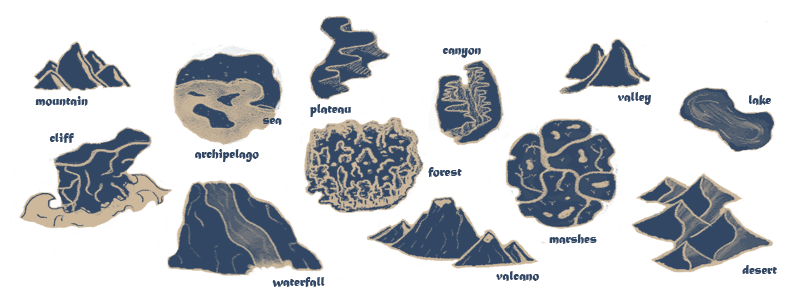
The concentration of diverse geographical features creates combinations that would be unlikely or even impossible in reality, yet this serves a crucial narrative purpose: heroes must traverse varied terrain, each landscape marking a stage in their journey.
Take Tolkien’s Middle-earth, the Fellowship’s six-month trek from the Shire to Mount Doom moves through forests, mountains, plains, marshes, and volcanic wasteland. Each terrain shift signals both physical progress and narrative transformation.
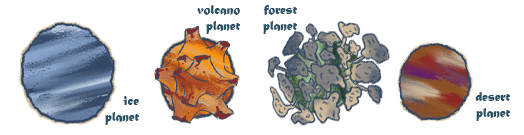
For some science-fiction worlds, the different geological features are symbolized as different planets, like Star Wars. (Tatooine as desert, Hoth as ice, Endor as forest, Mustafar as volcanic.)
secondary world maps: routes
Maps are important not only for showing what exists where, but also for the routes they provide between point A and point B. Being able to see these routes collectively is fundamental for imagining the world, both for the worldbuilder and the world-experiencer.
Maps, which make concrete how long journeys will take, reference time, which is one of narrative’s most essential elements. Sometimes the time spent traveling can be ellipsized in the story, yet it remains concrete for the map reader. The accessibility of regions to one another on the map, whether they are isolated or not, can be easily read, and this allows us to gain deep knowledge about the different regions. We can even learn about the ways of life of the creatures living there. These mapped routes and relationships anchor our understanding of a world.
secondary world maps: gestalten
Maps may not be fully complete due to gaps that arise when the narrative’s focus lies elsewhere. Perhaps the characters never visit a certain region on the map; their journey never passes through it. In such cases, the world-experiencer as map-reader can fill in the gaps through patterns on the map and in the narrative, or through other details.
World gestalt: A structure or configuration of details which together implies the existence of a world, and causes the audience to automatically fill in the missing pieces of that world, based on the details that are given. Usually, all the given pieces follow a certain logic, which helps dictate what the missing information might be like, allowing existing information to be extrapolated to fill in the gaps.1
secondary world maps and worldbuilders
maps, which are quite important for the world-experiencer, also hold great significance for worldbuilders. Maps are not merely tools presented to the reader as a final product, nor do they exist solely to be used during the creation of fiction. Maps are tools with a dual function that both worldbuilders and world-experiencers can use. For a worldbuilder, the map is the scale of consistency within the fiction, important for maintaining time and space coordination. Let’s mention the quote from Tolkien once again:
If you’re going to have a complicated story, you must work to a map; otherwise you’ll never make a map of it afterwards.
As the worldbuilder continues to develop their map in sync with their fiction, they can more easily see what they have not yet explored and add elements that will enrich the story.


Maps are more than illustrations or reference materials. They are invitations to worldbuilders and to audiences.
To worldbuilders, they offer structure and discovery; to audiences, they offer pathways and speculation.
In filling the unknown spaces of both primary and secondary worlds, maps remind us that imagination has always needed both: the drawn line and the blank space, the route and the mystery, what is shown and what remains hidden.
- Wolf, Mark J.P. Building Imaginary Worlds: The Theory and History of Subcreation. Glossary. ↩︎
 a bag of holding