*Alexander, Christopher. The Timeless Way of Building. New York: Oxford University Press, 1979.
I’ve been exploring connections between worldbuilding and architecture as a way to imagine what could be. Worldbuilding has developed particular ways of thinking about creation and emergence. I’m curious whether those ways of thinking could enrich architectural practice.
To gain a perspective, I read Building Imaginary Worlds1, written by Mark J. P. Wolf, and saw some traits that worldbuilding has. Now I am trying to rediscover them in architecture.
To do that, I’m currently reading Christopher Alexander’s book The Timeless Way of Building. Alexander argues that architecture has a language: A Pattern Language. According to him, the fundamental elements of space are patterns. When these patterns form relationships with each other, a language emerges. This language shapes structures, cities, and life itself. In his subsequent book A Pattern Language2, he catalogues these 253 patterns. We’ll talk about this in a moment.
In this entry, I want to share a few passages that resonated with me; perhaps they’ll clarify the connection I’m seeing.
generation over creation
What struck me most about worldbuilding was how such complex systems could be created in detail. I initially thought you’d need to map out every detail, answer every question, and establish every relationship. But the book, Building Imaginary Worlds, through examples, shows this isn’t necessary. In fact, doing this would create worlds that aren’t open to development. Instead of designing every element, worldbuilding develops the system that generates those elements.
This system shapes and limits additions, stories begin writing themselves, characters start controlling their own lives, and through the system, things the worldbuilder never initially considered begin to emerge. And this is what makes a world intuitive, progressive, but most importantly, alive.
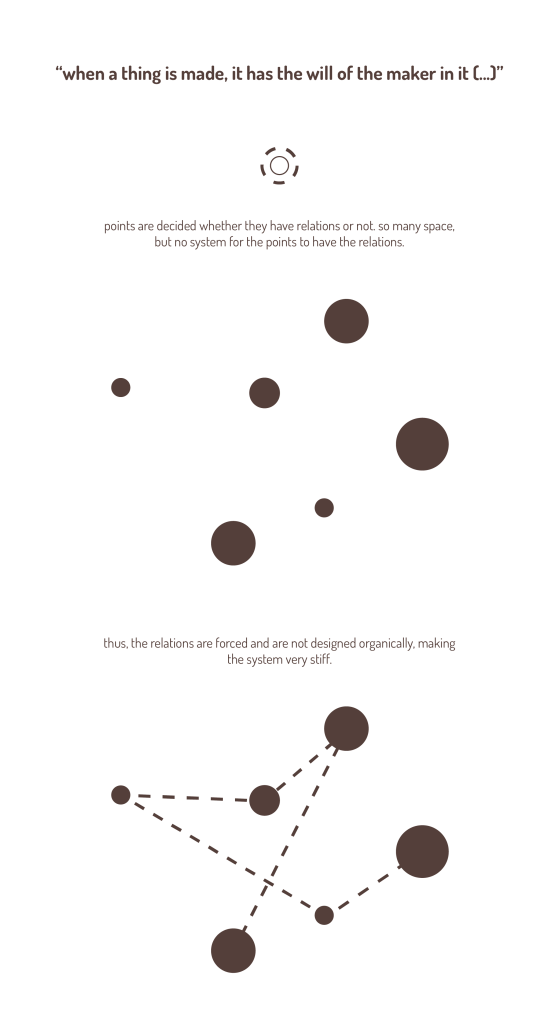
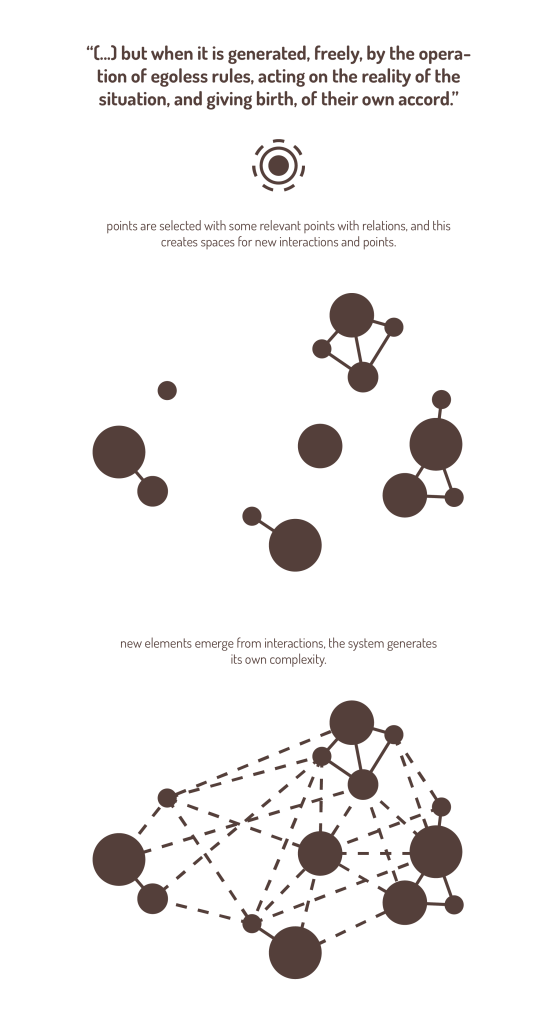
And Alexander, in The Timeless Way of Building, talks about these same qualities from a spatial perspective. He brings the sum of these qualities together in a single definition: the quality without a name.
"no word can ever catch the quality without a name because the quality is too particular, and the words too broad. and yet it is the most important quality there is, in anyone, in anything."
He argues that even though it cannot be named, we can still circle around some concepts-words to catch the overall meaning of the quality without a name: alive, whole, comfortable, free, egoless, eternal… In essence, Alexander says that patterns are reflections of this quality. When we create pattern languages to make patterns connected to one another and develop the system that previously mentioned, we can ‘generate’ life, not ’make‘ life.
Here, the parallel to worldbuilding becomes clearer. Both of them first want to understand life, what gives life, and then create conditions for this natural life to emerge.
the seed


here, I want to show how this ‘generation’ works in practice, through examples that both Wolf and Alexander give in their books.
generation in worldbuilding: tolkien
For Tolkien, “invented languages were the seeds from which his imaginary world grew3“. The seed, the linguistic system with its roots and rules, generated not just words, but entire cultures, histories, and mythologies.
In a 1956 letter, he described how the world logic he had created began to generate content independently: “…I wait until I seem to know what really happened. Or till it writes itself. Thus, though I knew for years that Frodo would run into a tree-adventure somewhere far down the Great River, I have no recollection of inventing Ents4“. The Ents weren’t “made” by Tolkien; they were “generated” by Middle-earth’s internal logic.
generation in architecture: the porch5

In the book a pattern language, alexander shows us how he built a porch onto the front of a house. He didn’t start by designing the porch’s form; he first chose ten patterns that could relate to a porch, and that way, he established a small language, and this small language generated this porch.
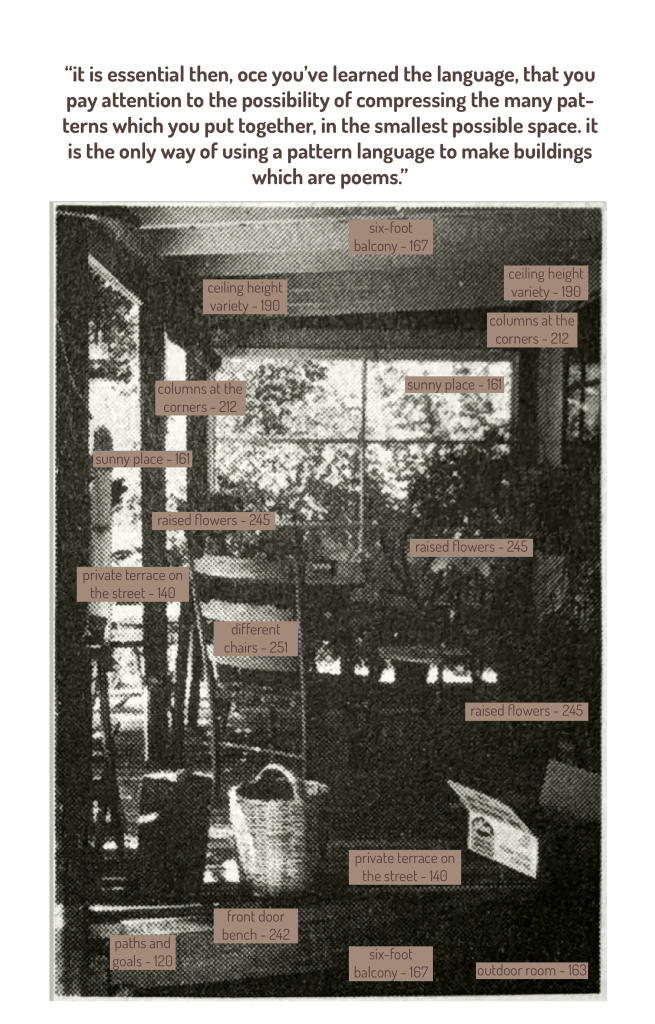

In conclusion, the architect didn’t design the porch; the pattern language, responding to site, climate, culture, and neighboring patterns, generated it.
the gap
I should be clear: I am not arguing a concrete proposal for how to apply worldbuilding methodology to architecture. Maybe there isn’t one, and perhaps such a direct translation isn’t possible, or even desirable. Worldbuilding and architecture operate under fundamentally different constraints: one creates fictional worlds free from physical law; the other must negotiate gravity, budget, building codes, and human safety. What I do have is a parallel that won’t leave me alone: two practices, one is all about people and spaces, the other is about creatures (often including people) and the spaces surrounding them. I know the gap exists between these two similar yet different practices, and I know seeing it matters. Sometimes recognizing a pattern is the first step toward working with it. Perhaps by seeing it articulated so clearly in worldbuilding practice, architecture can take it into consideration: to generate rather than make.
- Wolf, Mark J. P. Building Imaginary Worlds: The Theory and History of Subcreation. New York: Routledge, 2012. ↩︎
- Alexander, Christopher, Sara Ishikawa, and Murray Silverstein. A Pattern Language: Towns, Buildings, Construction. New York: Oxford University Press, 1977. ↩︎
- Wolf, Mark J. P. Building Imaginary Worlds: The Theory and History of Subcreation, p.189 ↩︎
- Wolf, Mark J. P. Building Imaginary Worlds: The Theory and History of Subcreation, p.54 ↩︎
- Alexander, Christopher. “Understanding a Pattern Language.” A Pattern Language. Accessed February 20, 2026. https://www.patternlanguageindex.com/understanding-a-pattern-language. ↩︎
 a bag of holding