Architecture, worldbuilding, and design process as a language, these are the three fields I keep returning to in this casebook. I might be wrong at times for trying, as not many architects relate to these three fields in particular. But I think it is important to bring them together by finding common things and even differences, because I believe that architecture can gain various perspectives when related to these fields. And by gaining perspective, architecture should start to become a common medium like writing or creating different worlds for people.
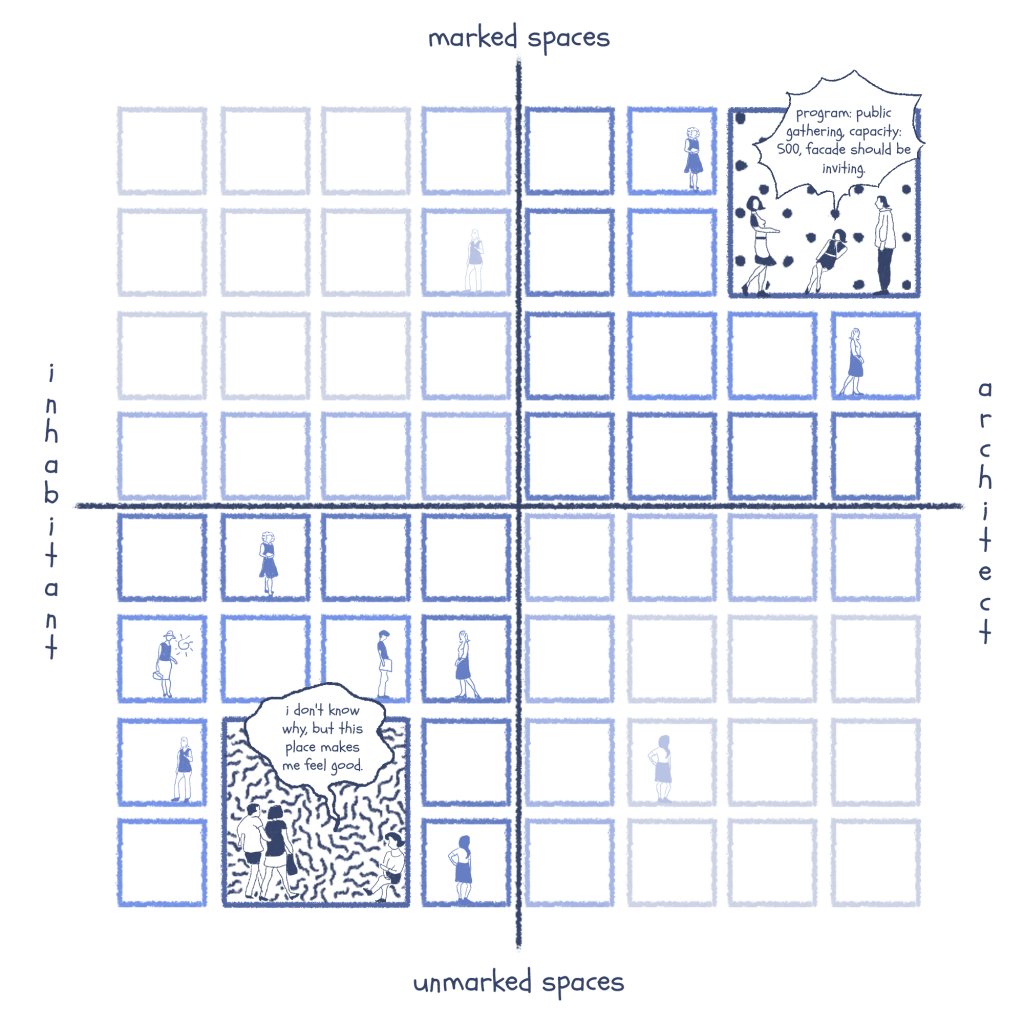
And in this entry, I will explore more about language and architecture. Using space to express oneself through architecture is mostly assigned to architects, but seeing spaces, living inside them, belongs to anybody. This is one of the reasons why relating architecture to language is important, as it points toward a unified experience between the one who designs the space and the one who lives in it.
When I see people in these fields talking about or pointing towards this unified experience, I get excited. And Roland Barthes, in his lecture Semiology and the Urban, made me excited.
I don’t have enough knowledge on linguistics, semantics nor in syntaxes; but as I am able to think in a language and express myself with it, I know that it has a system that works with units (such as words, punctuation…) and the relation between these units (sentences, paragraphs…). We can observe these units and relations easily.
And as an architecture graduate and an ordinary human that lives in spaces, I can easily sense that architecture is a language as well, but I can not surely know it, as the units or the relation between them is yet to be defined clearly. Why can’t we define these specifics of a language for architecture, then? Because it is not possible to define without analyzing the “language”, and because our tools for analyzing architecture as a language are not enough. This is why Barthes talks about “the possibility of a semiotics of the city” in his lecture, to raise attention to “how to pass from metaphor to analysis when we speak of the language of the city”. I am going to quote him to make a brief summary:
The city is a discourse and this discourse is truly a language: the city speaks to its inhabitants, we speak our city, the city where we are, simply by living in it, by wandering through it, by looking at it. Still the problem is to bring an expression like ‘the language of the city’ out of the purely metaphorical stage.
Although some architects and theorists have worked on this subject, one reason we lack these tools is the gap between architects and the people living in the space. Traditionally, architects are thought to be the only ones who can speak through architecture; therefore, only architects own the language. This creates the gap I mentioned. Architects speak another language, which they use to create spaces, and this language is not the same as the language that I am talking about. Language used for creating spaces is a temporary thing for a building or a city’s lifetime. What is permanent is the other language, the language between the space, the architect, and the inhabitant of the space. I believe that to close the gap, architects should realize that this second language, the permanent one, is very important. Speaking only the first language can give birth to many beautiful, but in this scale, small things, and it is not enough to give birth to a beautiful city that speaks. I will let Barthes talk again:
This is why I would say that it is not so important to multiply the surveys or the functional studies of the city, but to multiply the readings of the city, of which unfortunately only the writers have so far given us some examples.
To understand the permanent language, the city’s language (and even the city as a language), Barthes thinks it is very important to let the inhabitants talk and think about the city as well. And I believe this is true on so many levels, as I said, language requires at least two sides. And a language is better understood in dialogue. The inhabitant can help to create a dialogue this way. To create a dialogue means creating a dynamic relationship. And this dynamic relationship should never seek to fix the meaning of what it finds:
Starting from these readings, from this reconstruction of a language or a code of the city, we could then turn to means of a more scientific nature: definition of units, syntax, etc., but always keeping in mind that we must never seek to fix and rigidify the signified of the units discovered, because, historically, these signifieds are always extremely vague, dubious and unmanageable.