i’ve read the book called “zen and the art of motorcycle maintenance”. it was very intriguing to read, as it made me relate it to my environment and perspective. (spoilers ahead)
i liked pirsig’s idea of making the book a chautauqua1 and a real-life documenting tool at the same time. it reminded me of my chautauqua, my entries. and today, this chautauqua will be about “quality”.
quality is the central concept as phaedrus (the main character who will turn out to be pirsig himself) obsesses over throughout the book.
the concept of quality emerges from the criticism of what is accepted as classical and romantic understandings. the distinction between art and the motorcycle maintenance. the distinction between aristotelian logic and eastern mysticism (zen buddhism). taking a classical approach to motorcycle maintenance means breaking the engine down into its components to solve problems in a rational manner, while the romantic category perceives the world in a holistic, aesthetic, and intuitive way. as we can see from the title of the book, pirsig hoped to develop a unifying understanding of his own.
Classical understanding is concerned with the piles and the basis for sorting and interrelating them. Romantic understanding is directed toward the handful of sand before the sorting begins. Both are valid ways of looking at the world although irreconcilable with each other. What has become an urgent necessity is a way of looking at the world that does violence to neither of these two kinds of understanding and unites them into one. Such an understanding will not reject sand-sorting or contemplation of unsorted sand for its own sake. Such an understanding will instead seek to direct attention to the endless landscape from which the sand is taken. That is what Phaedrus, the poor surgeon, was trying to do.
this endless landscape is where quality lives, or rather, as pirsig suggests, quality is what makes the landscape possible in the first place.
but, i must follow a certain order to show how phaedrus approached the concept of quality, otherwise i would be doing a job without quality myself. i’ve created a diagram where Phaedrus’s line of reasoning, and his mind collapsing can be traced.
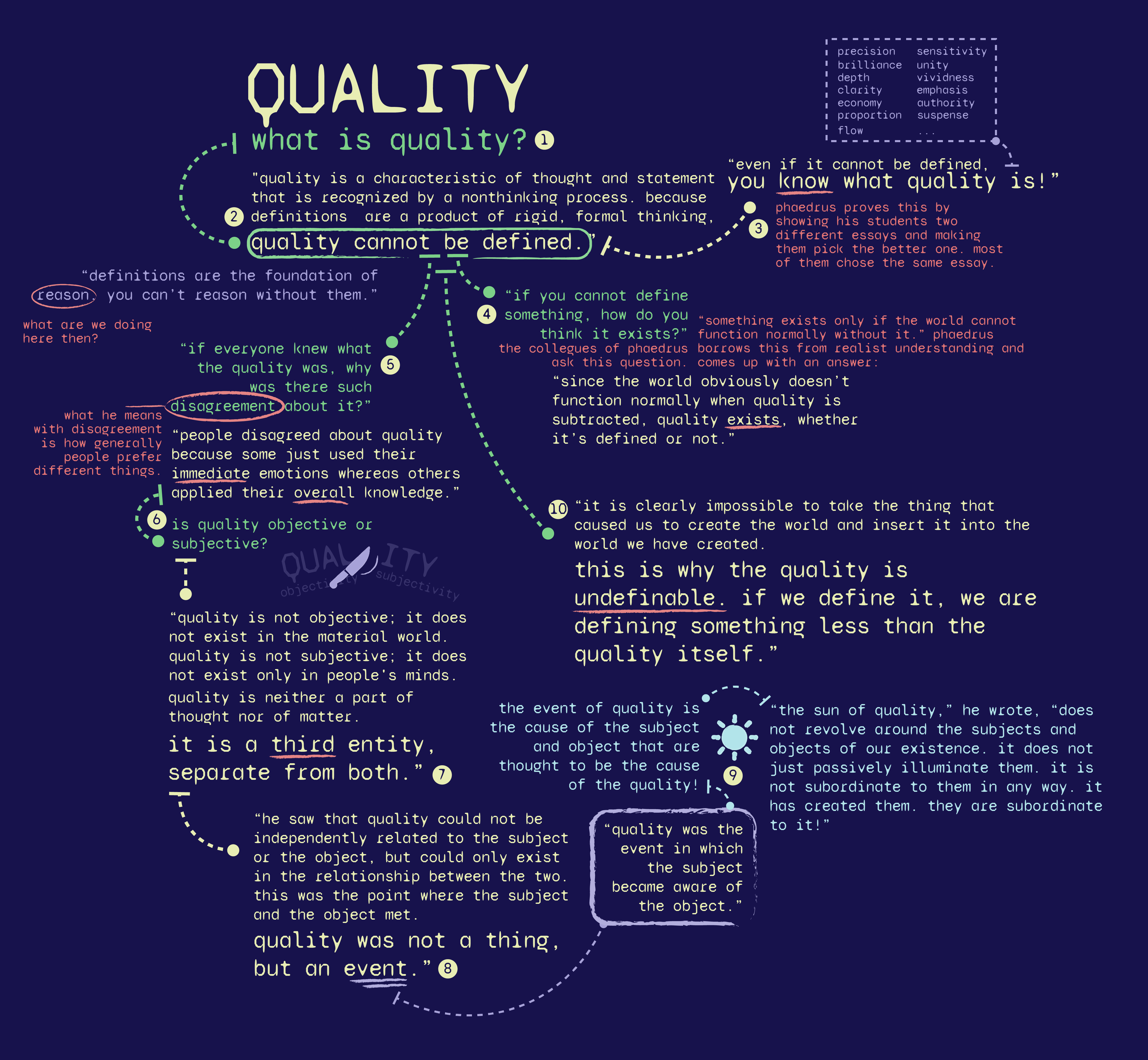
to summarize: phaedrus knows that quality cannot be defined, because whenever he tries, something goes wrong. yet he is also aware that quality can be identified by people, even if in different ways (which he attributes to their backgrounds, environments, and prior knowledge). he observes that this variation between individuals is not sufficient to describe quality as subjective, since quality is neither subjective nor objective: it does not exist only in the material world, nor only in the minds of people. so he declares it not as matter or thought, but as a third entity in its own. an entity that is not born from the subject or the object, but from the relationship between them. an event, in fact. the cause of both subject and object. the world itself.
with this, the understanding of quality he had set out to find at the beginning, the one that would bridge the gap between the classical and the romantic, arrives at a resolution. he finds that different cultures have different words for this same concept. poincaré’s harmony, lao tzu’s tao… and suddenly, everything falls into place, and this is where phaedrus breaks.
quality is an event. and its actors are the subject and the object. i can see this more clearly in architecture, which is the profession i studied and practice. in establishing the balance between a building’s aesthetic values and its structural techniques and functions, in the relationships a building holds within itself and within its context… in all these balances, what seems to happen is a collision between the building itself and what people bring to it from their origins, their ways of thinking, and their cultures. and what is that collision, if not quality?
let us return to what phaedrus first set out to do in the book. can quality be taught, and if so, how? since quality is fundamentally an event, we should say that it is something to be experienced rather than defined through concrete terms. in that case, when we speak of quality in architecture, we must ask how many quality buildings a person has actually lived alongside. especially in our growing cities today, the newly constructed buildings shape a standard architectural understanding in people’s minds. for a person to be able to imagine a quality building, they must surround themselves with quality buildings. in the age of information, the barriers to achieving this may be falling. but that is not the question of this chautauqua.
i believe that more effort must be made and more people must join this conversation for the question of quality in architecture to receive the attention it deserves. i will leave the ways of doing this to my next chautauqua. but since i think your responses would contribute to exactly what i mean, i am leaving a form below. sharing your thoughts would show me that we are building this idea of quality together, and that would make me very happy.


- chautauqua is some kind of a “tent show” that tours around america and educates people on different topics. much like radios of old times. ↩︎
 a bag of holding