to be honest, i have been trying to bring out this piece, the second of my writings titled “on quality,” for a long time now, but i could never quite settle into it.
what pushed me to write it was an encounter that happened before i had even read pirsig. the concept of quality i discussed in entry 27. – on quality was not the first “quality” i had run into. another one, developed by christopher alexander, held an important place in two of his books that i read (the timeless way of building1 and a pattern language2). i had mentioned these two books earlier in entry 21. – the timeless way of building*, but i had not dwelt much on “quality” itself there. still, if you read those entries, the connection will be easier to see. in this entry i will build relationships between alexander’s “quality” and pirsig’s “quality,” and try to develop some thoughts about what quality is, or could be, in architecture.
the timeless way of building, as its name suggests, describes the qualities of a timeless architecture. its most important actor is said to be “the quality without a name.” it is through quality that the beauty of a building becomes discernible. alexander tries to explain this central actor, which he calls the quality without a name, from many different angles, yet he always insists that it can never be named. below, through a series of comparisons, i will try to lay out both writers’ thoughts and bring their differences and similarities into the open.
the quality without a name

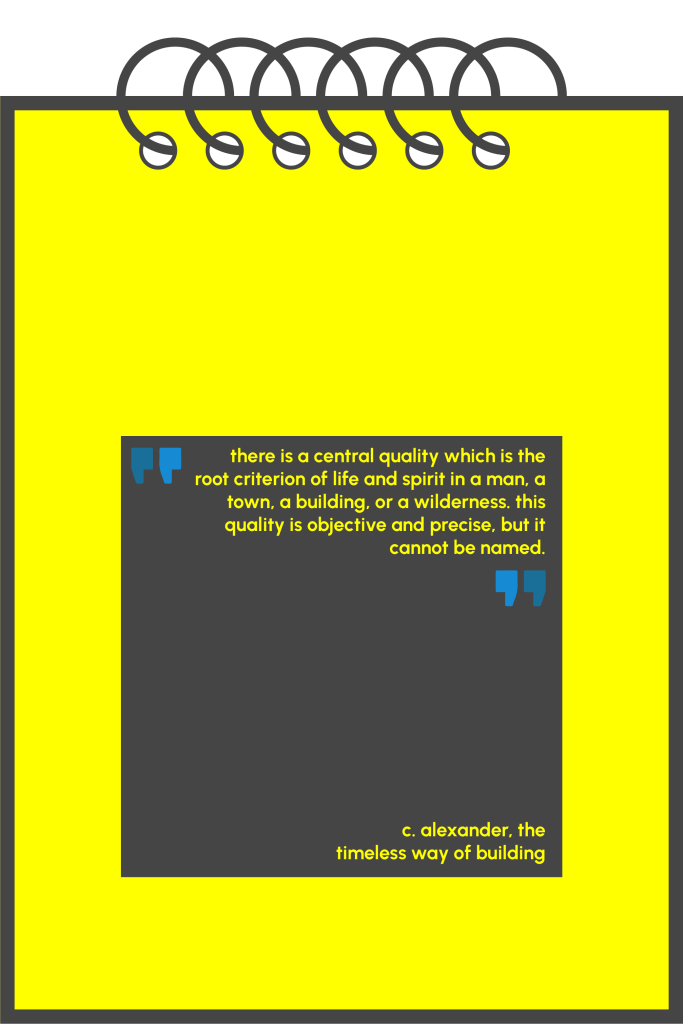
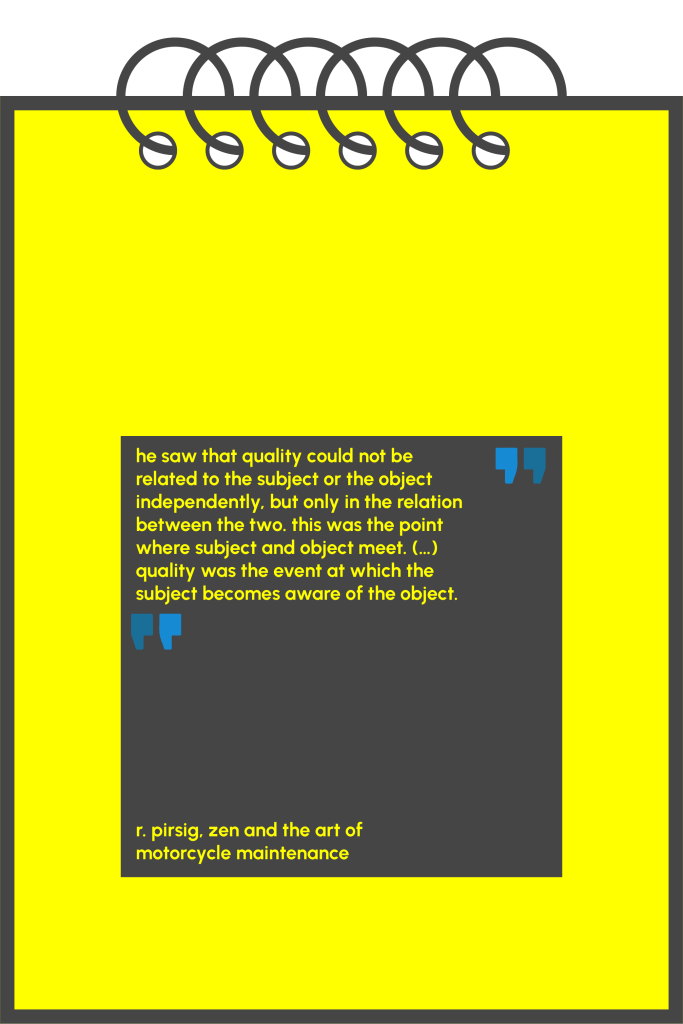
alexander’s first sentence about quality matches pirsig’s concept almost exactly, but the characteristics he then assigns to it, being objective and precise, create a tension between the two. for alexander, quality cannot be named, yet it is objective and precise. it is in fact so precise that no word can ever meet it, and this is why it cannot be named. for pirsig, too, quality cannot be defined, but for a different reason: it is not a thing, it is an event. this event is neither objective nor subjective; it is the moment where object and subject come to stand side by side. the meeting of the subject (inhabitant/visitor3) and the object (the building) is the very initial matter of architecture, and quality in architecture begins right here.

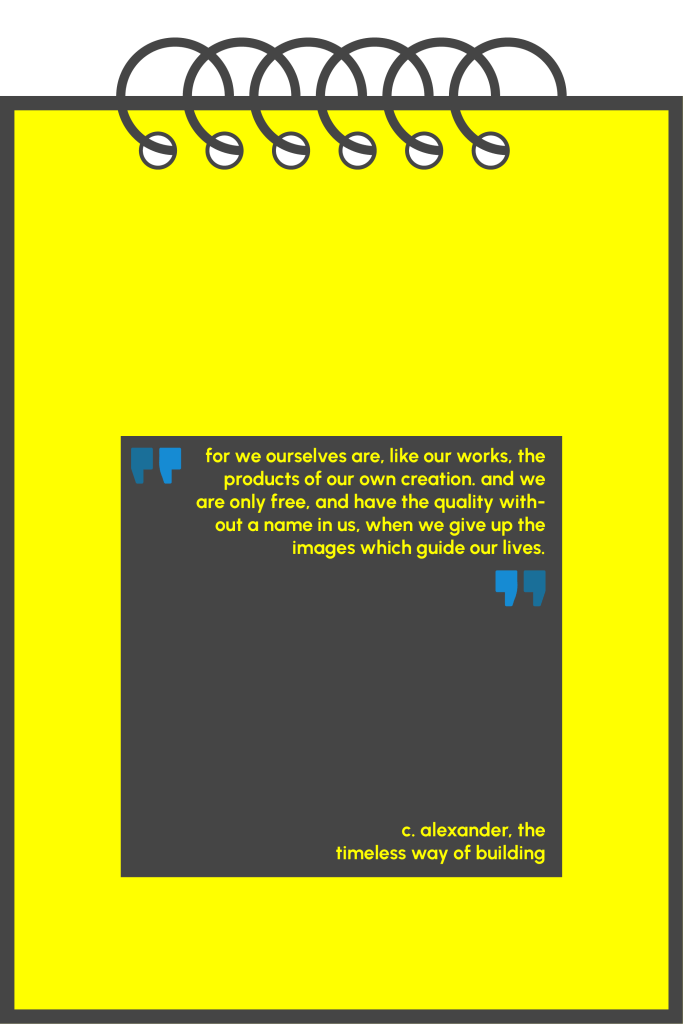
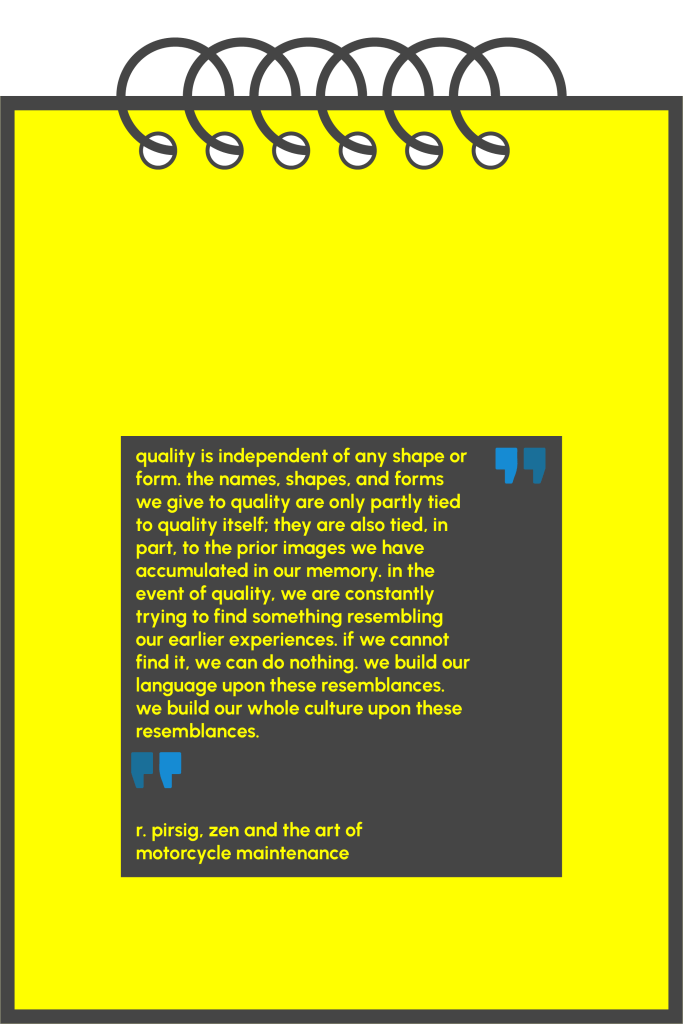
both writers underline the presence of the “prior image” and agree that it matters for human beings, that as long as we exist these images will always be with us. but with one difference: for alexander, in design process, giving up the image is both possible and necessary, while for pirsig the images are culture itself, and giving them up is impossible. alexander, thinking that the architecture of his own period was overwhelmingly “without quality,” believed that those who labor in this field must move away from these examples that lack quality and strive to bring out something new. we could say this still holds true, that quality architecture remains a minority and is less familiar to people. pirsig, on the other hand, says that fully giving up prior images is not an option: in our worlds, saturated with resemblances, two entirely unrelated things can never be produced. so while the two writers approach the prior image differently, we cannot dismiss what follows from this for us. those of us behind the idea of quality architecture have to develop our prior images, enlarge them, and fill them with more quality. when prior images are filled with quality works, the chance of producing something without quality goes down. and especially in the information age we live in, this should not be too difficult an option.

from here on, alexander begins to descend into the depths of his own theory. for him, patterns are the sentences of the architectural language. if the aim is, in the end, a language that everyone can understand, then patterns are the stage that comes after words in the hierarchy of this architectural language. they are the smallest meaningful part of a building that has quality.
and we should focus on something here: alexander tries to find quality, the very thing he calls unnameable, by breaking the architectural language into its parts, by draining out its essence. and in the design stage he imagines the reverse: that from this essence of the architectural language a sentence, or a paragraph, with quality can be built. the 253 patterns he lays out in a pattern language serve exactly this purpose. they aim to explain quality to people by starting from the small parts of the architectural language.
pirsig would say that such an act is wrong, that perhaps the point is not to recreate quality but to observe it better. alexander’s defense, as i see it, is that the language no longer lives on its own, and that in order to bring it back to life, making the unnameable quality nameable, or at least experienceable, becomes important.
intuition
i think the concept of quality, which both writers spent their lives on, is an area that needs to be thought about and produced within the architectural language, and within architecture in general.
following only pirsig’s path, trying to keep quality alive, will produce architects and societies that feel quality but cannot build it. following only alexander’s path will produce mechanical work, made by people who can recognize quality in its various patterns but have never lived quality as a whole. for quality architecture, both are necessary in different dimensions: the two views must exist at the same time, in the same person, the same society, the same city, the same building, so that real quality can find a place for itself in architecture.
- alexander, christopher. the timeless way of building. new york: oxford university press, 1979. ↩︎
- alexander, christopher. a pattern language. new york: oxford university press, 1977. ↩︎
- i’ve used this term (visitor) in my previous entries, it is a reference to tolkien’s “visitor”s of the fantastic worlds. ↩︎

